Jazz Resources

Jazz isn’t dead, it just smells funny. ~Frank Zappa

I don’t care too much about music. What I like is sounds. ~Dizzy Gillespie
——–
This coming weekend I’m hosting at the computer lab at the Evanston Township High School Jazz Festival, a jazz fest for high school jazzers in and around the Chicago area. I’m putting together some resources that the budding jazz musician will find helpful, including listening, blogs, freeware, software, podcasts, and anything else that might be useful. Some of the software I’ve mentioned in one or two earlier posts (Sibelius, Aviary, NoteFlight, Audacity, Band in a Box, etc). I’ll put links to that software here, but won’t go into much detail. If you’re not into playing jazz, you should certainly check out some of the listening opportunities. Great stuff there…. Enjoy!

Tiny Grains of Sand: The Warmup and the Breath

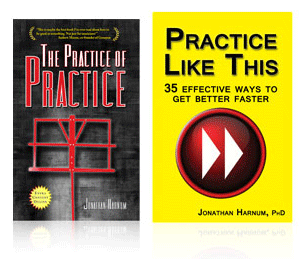
We see past time in a telescope and present time in a microscope. Hence the apparent enormities of the present. Victor Hugo ——— Want to learn more about the best ways to practice? Get an e-mail with a discount code when The Practice of Practice is published (June, 2014). To learn more about the book,…

Geurrilla Practice

The conventional army loses if it does not win. The guerrilla wins if he does not lose. ~Henry Kissinger The guerrilla must move amongst the people as a fish swims in the sea. ~Mao Zedong ______________ What do you do with your down time? On the train or bus, walking with your hands in your…

Hatian Relief

The tragic circumstances in Haiti need our attention. Give if you can. Because Evan Tobias is both eloquent and informed, and says it better than I would, I’ve provided the following image linked to his post on some musician’s response to sending Haitian relief : Thanks, Ev. Want to learn more about the best ways…

Evidence of Motivation

In every artist there is a touch of audacity without which no talent is conceivable. ~Johann Wolfgang von Goethe (1749-1832) Success is the child of audacity. ~Benjamin Disraeli (1804-1881) Hope begins in the dark, the stubborn hope that if you just show up and try to do the right thing, the dawn will come. You…

It IS about you…

Have you ever been out in the world, going somewhere, sure of the direction you’re headed when in a flash you realize that you’re actually headed in the opposite direction? It’s such an odd and sudden shift of perspective, as if the entire world suddenly snaps to a new orientation. But it’s not the world that shifts, it’s you. Every now and then I get that same feeling from something I read. It could be the first time I read a new author (Bradbury, O’Connor, Vonnegut), or some piece of research, like a study by Carol Dweck, the subject of this post.

It’s not about you…

Motivation is the grease and the ball bearings in the wheels of our music practice. Without motivation, absolutely nothing would happen. It’s as essential as the breath you breathe. Thing is, motivation is a slippery notion that tends to slip away when you try to wrap your mind around exactly what it is, where it comes from, and how it works. There are the usual things like listening to great music, going to see musicians live and talking to them if possible, but this is surface stuff. Motivation goes much deeper. There are two important aspects of motivation I’d like to throw out for you to chew on: goals (specifically what researchers call goal orientation), and your implicit theories on both intelligence and “talent.”

Performance as Practice

Nicholas Barron says he’s never practiced. A lot of people can say that, right? But how many are musicians who can play and sing like this:

Your Plastic Brain (redux)

Learning changes your brain structure. My neurons underwent some serious alteration this weekend, all naturally induced, thank you very much. One of the world’s foremost grand masters of the djembe, Mamady Keita (vid to follow), was in Chicago to give beginning-, intermediate-, and advanced drum workshops. I’ve never had a djembe lesson before. I signed up for the beginner session and would learn very quickly what “beginner” actually meant to this crowd. Good thing I didn’t know that Keita’s definition of “beginner” is most people’s definition of, “I know what I’m doing.” If I’d known this, my stomach would’ve been in even more of a knot about showing up with little to no real djembe experience. Nothing like a good challenge to get you to really pay attention.

Circle (of Fifths) Your Wagons!

If you’re practicing a melodic instrument, the circle of fifths (also called the cycle of fifths or circle/cycle of fourths) is a fantastic tool to help you navigate most musical waters. It’s a tool that helps to explain how music moves harmonically, and applies to almost all forms of tonal music. When you practice your scales or chord progressions, this guide can help you practice them in the way that you’ll find them in actual performed music. If you practice scales in this order, you’ll be doing double duty: not only will you be getting the scales/chords under your fingers, but you’ll be practicing the order in which you’ll find them and you’ll be getting the sound of how these move from one to the next into your consciousness.

Let Your Dim Light Shine

It’s hard to maintain a belief that you can get a lot of joy out of doing something at less-than-professional levels when you’re surrounded by a culture that tells you otherwise, but I would like to say that not only is it possible, but it’s the norm. If all musicians in the world took a survey on this issue, we’d find that there are many more happy amateur musicians out there than there are happy professionals. We should all let our lights shine and celebrate not the intensity of the light, but that it shines at all.

Practicing Tempo

I got bored with the old way – it came too easy. I worked until I could play chord changes at any tempo in any key, and then said ‘What else is there?’ Now I’m finding out. — Don Ellis, trumpeter, drummer, composer The tempo is the suitcase. If the suitcase is too small, everything…