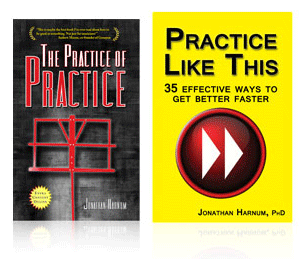
We see past time in a telescope and present time in a microscope. Hence the apparent enormities of the present. Victor Hugo ——— Want to learn more about the best ways to practice? Get an e-mail with a discount code when The Practice of Practice is published (June, 2014). To learn more about the book,…
Category: video
Evidence of Motivation
In every artist there is a touch of audacity without which no talent is conceivable. ~Johann Wolfgang von Goethe (1749-1832) Success is the child of audacity. ~Benjamin Disraeli (1804-1881) Hope begins in the dark, the stubborn hope that if you just show up and try to do the right thing, the dawn will come. You…
It IS about you…
Have you ever been out in the world, going somewhere, sure of the direction you’re headed when in a flash you realize that you’re actually headed in the opposite direction? It’s such an odd and sudden shift of perspective, as if the entire world suddenly snaps to a new orientation. But it’s not the world that shifts, it’s you. Every now and then I get that same feeling from something I read. It could be the first time I read a new author (Bradbury, O’Connor, Vonnegut), or some piece of research, like a study by Carol Dweck, the subject of this post.
It’s not about you…
Motivation is the grease and the ball bearings in the wheels of our music practice. Without motivation, absolutely nothing would happen. It’s as essential as the breath you breathe. Thing is, motivation is a slippery notion that tends to slip away when you try to wrap your mind around exactly what it is, where it comes from, and how it works. There are the usual things like listening to great music, going to see musicians live and talking to them if possible, but this is surface stuff. Motivation goes much deeper. There are two important aspects of motivation I’d like to throw out for you to chew on: goals (specifically what researchers call goal orientation), and your implicit theories on both intelligence and “talent.”
Performance as Practice
Nicholas Barron says he’s never practiced. A lot of people can say that, right? But how many are musicians who can play and sing like this:
Your Plastic Brain (redux)
Learning changes your brain structure. My neurons underwent some serious alteration this weekend, all naturally induced, thank you very much. One of the world’s foremost grand masters of the djembe, Mamady Keita (vid to follow), was in Chicago to give beginning-, intermediate-, and advanced drum workshops. I’ve never had a djembe lesson before. I signed up for the beginner session and would learn very quickly what “beginner” actually meant to this crowd. Good thing I didn’t know that Keita’s definition of “beginner” is most people’s definition of, “I know what I’m doing.” If I’d known this, my stomach would’ve been in even more of a knot about showing up with little to no real djembe experience. Nothing like a good challenge to get you to really pay attention.
Let Your Dim Light Shine
It’s hard to maintain a belief that you can get a lot of joy out of doing something at less-than-professional levels when you’re surrounded by a culture that tells you otherwise, but I would like to say that not only is it possible, but it’s the norm. If all musicians in the world took a survey on this issue, we’d find that there are many more happy amateur musicians out there than there are happy professionals. We should all let our lights shine and celebrate not the intensity of the light, but that it shines at all.
Deaf Musicians?
It amazes me what some people have gone through in order to play music, and it makes me realize (once again) that the passion and drive to have music in one’s life is more powerful than more paltry things like knowledge of how to practice. One researcher whose name slips me at the moment, calls…
A Key to Practicing Tunes in All Key Signatures
If you want to really learn a tune, you should learn it in every key. Start by learning it in all the regular keys, like Bb, C, D, etc. Basically, the regular keys are those with the least amount of accidentals. On a side note, learning tunes in all keys also includes, indirectly, learning scales…
Wind = Music
Most of us in the United States have resources beyond the wildest dreams of billions of other people less fortunate in the world. Our technology and relative wealth allow us the time to study music or other arts, to surf the Internet, to speak with friends and loved ones at the touch of a button….
Thoughts on Art and Hip Hop
Art is the most intense mode of individualism that the world has known. –Oscar Wilde. I am for an art that takes its forms from the lines of life itself, that twists and extends and accumulates and spits and drips and is heavy and coarse and blunt and sweet and stupid as life itself. –Claes…
Slow Down, You Move Too Fast (Audacity tutorial)
This post will give you a quick tutorial on how to slow down a fast tune with Audacity so you can learn it by ear more easily.
If you’ve listened to any Clifford Brown, the fantastic jazz trumpeter, you’ll know he’s able to play tasty, tasty licks at burning speeds. The first CB solo I tried to learn was from his tune, Blues Walk (click to hear a snippet of the solo), but it was way too fast. I imported the whole tune to Audacity, edited it so only his solo remained, then slowed it down (sometimes by as much as 50%!). After nailing it at a slow tempo, I’d gradually speed up until I could play it at full speed. This will work for anything you want to learn by ear, a skill that too many students don’t have in their tool belt because our current music education system has tied them to the notes on the page. This is a handicap. Use your ears. Please!
 The Practice of Practice