There are worse musicians to emulate than Irving Berlin. He penned God Bless America, and the perennial classic White Christmas along with a whole host of other popular songs. Any songwriter would relish the royalties of either of these tunesand would probably both give their eyeteeth to have written them. Berlin knew the value of work. He didn’t believe in inspiration, but in effort. He wrote a song a day, regardless of fickle”inspiration.” The wonderful thing is that all of these musical accomplishments weren’t hampered by Berlin’s inability to read or write kusic. In fact, later in life, Berlin was convinced this inability was one of the factors in his success. He wasn’t limited by written music.
Category: Master Musicians
Grow an Inner Carrot, Forget the Stick
One thing the research record tells us is that incentives and other forms of extrinsic motivation don’t work very well to motivate us, nor do punishments. Carrots and sticks only work if you’re an ass. Much better is motivation that comes from within, or intrinsic motivation. And sometimes training can be a hindrance, too, as you’ll see in the vid below. Because I’m buried in research, I don’t have much time this week to post a lengthy article, but this thought-provoking TED talk is a great way to see the real-world example of how incentives often mean horrible performance, and training isn’t always a good thing. Learn the simple reason why kindergarten kids beat out MBAs in a design challenge…
Michel Godard Plays a Serpent
This is an excellent musical performance, and interesting to boot! The frame drum solo at the beginning drew me right in, and when Michel Godard began to play the serpent I was entranced. Godard’s ear and lip control put him completely in tune with the singer. A haunting mix of sounds. Vocals are provided by Linda Bsiri, and the masterful tef playing is by Jarrod Cagwin . According to the comments it’s both a sephardic tune, La Rosa Enflorese and is also known as Los Biblicos, traditional. I don’t know how accurate those comments are. Facts on the Internet are like notes on a trombone: Infinite in number, but most of them are wrong.
Wynton’s Artistry
No quotes, few words of mine so you can get to what Wynton Marsalis has to say (and sing):
If you cherish art, music, freedom, laughter, poetry, and masterful performance, you need to watch this.
http://www.wyntonmarsalis.org/2009/04/10/video-nancy-hanks-lecture-at-kennedy-center/
Jamming with Butterflies (in a pool of water)
just heard about Hermeto Pascoal, a guy Miles Davis said was “the most impressive musician in the world”. I’m amazed by how many flavors of musician are in the world and am equally stunned when I find yet another important one I’ve never heard of and wish I’d discovered much earlier. Hermeto Pascoal is from Brasil, and this is how he does it (PS: the riot of yellow butterflies that come to dance around their heads are worth waiting for @ 2:30…. (big thanks to Meara O’Reilly on BoingBoing for this one):
Huge Chunk of Awesomeness
A wii remote, percussion, a bunch of servos and solenoids, some 12-tone set theory algorhythms (that word’s a joke, not a typo :-), looping functions, machine improvising and you get this huge chunk of awesomeness. First a performance and then how it’s done. This is so cool and amazing I simply don’t know what to say. Watch Patrick and his “band” Jazari and be inspired and flabbergasted. I wonder how he practices…..
Fail Better
In a previous post I spoke of the necessity of failure. I mentioned Buddha’s belief that the obstacle is the path, and when watching an interview with olympic speed skater Apolo Ohno, I’m reminded of it again, but in a different way. Here’s the thing:
After the 1500 meter race in which he won bronze, thereby becoming the most decorated American winter olympic athlete, Ohno said something interesting in an interview after the race. He was clearly happy, but spoke about a little bobble near the end of the race, when the Canadian skater bumped him as they went around a turn and Ohno’s skate stuttered. What did Ohno say in the interview? Did he blame the dastardly Canadian for bumping him? No. He took full responsibility for the stumble and wondered (I’m paraphrasing), “If I hadn’t messed up there I might have placed better.” Ohno is giving a perfect positive example of what researchers have called attribution theory, or what I like to call, The Blame Game. Here’s how it works:
Time, time, time, is on your side (yes it is)
And I like messing around in the engine room of music. Seeing what happens in the rhythm section area. Bill Bruford
_______________________________
If you’re interested in playing music, you’ve gotta have rhythm. If you think you don’t “have it,” consider the words of Taylor, a teacher, djembe-player, and all around good guy. Taylor has students feel their heartbeats. It’s a rhythm we all have. But it’s an internal rhythm, and it’s part of an unconscious rhythmic ability we all receive when we receive a heartbeat from our parents. We may have trouble making that natural rhythm come out consciously under control. But that, too, can be practiced.
Tiny Grains of Sand: The Warmup and the Breath
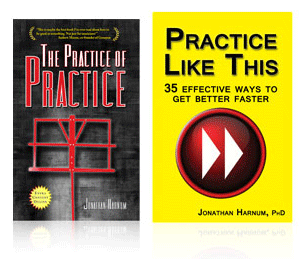
We see past time in a telescope and present time in a microscope. Hence the apparent enormities of the present. Victor Hugo ——— Want to learn more about the best ways to practice? Get an e-mail with a discount code when The Practice of Practice is published (June, 2014). To learn more about the book,…
Your Plastic Brain (redux)
Learning changes your brain structure. My neurons underwent some serious alteration this weekend, all naturally induced, thank you very much. One of the world’s foremost grand masters of the djembe, Mamady Keita (vid to follow), was in Chicago to give beginning-, intermediate-, and advanced drum workshops. I’ve never had a djembe lesson before. I signed up for the beginner session and would learn very quickly what “beginner” actually meant to this crowd. Good thing I didn’t know that Keita’s definition of “beginner” is most people’s definition of, “I know what I’m doing.” If I’d known this, my stomach would’ve been in even more of a knot about showing up with little to no real djembe experience. Nothing like a good challenge to get you to really pay attention.
Book Review: “Effortless Mastery” by Kenny Werner
Creating a new theory is not like destroying an old barn and erecting a skyscraper in its place. It is rather like climbing a mountain, gaining new and wider views, discovering unexpected connections between our starting points and its rich environment. But the point from which we started out still exists and can be seen,…
Deaf Musicians?
It amazes me what some people have gone through in order to play music, and it makes me realize (once again) that the passion and drive to have music in one’s life is more powerful than more paltry things like knowledge of how to practice. One researcher whose name slips me at the moment, calls…
 The Practice of Practice