Last Saturday at the Lionel Hampton Jazz Festival, I went to listen to Victor Wooten give a clinic. A while ago I posted a review of Victor’s book The Music Lesson, which is up for an audiobook award. For the clinic, Victor Wooten played with the fantastic and funny bass player (yes, there is another bass player in his band) Anthony Wellington; legendary jazz bassist John Clayton showed up for an improvised tune or two. The clinic was a fantastic example of playing, teaching and telling it straight. It was so good and inspirational, I knew it would be worth sharing.
Tag: music practice
Cross-Training
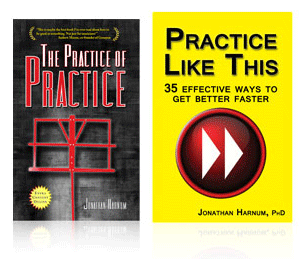
We all should know that diversity makes for a rich tapestry, and we must understand that all the threads of the tapestry are equal in value no matter what their color. ~Maya Angelou ——————- Want to learn more about the best ways to practice? Get an e-mail with a discount code when The Practice of Practice…
The Habit of Motivation and Barking Against the Bad
Every moment of one’s existence one is growing into more or retreating into less.
~Norman Mailer (1923 – 2007)
If you have made mistakes, even serious ones, there is always another chance for you. What we call failure is not the falling down but the staying down.
~Mary Pickford (1893-1979)
—
Plumbing the depths of motivation is a long unending process. Previous posts in this blog contain other aspects of motivation, including some theories about why we persist in difficult tasks. Today I want to shoot from the hip and talk about my own informal experience with and opinions about motivation. No theory. No rigorously tested hypotheses beyond those done subconsciously or haphazardly. Just two things that are on my mind.
When is Not-Practicing Practice?
A new piece of research shows that the “inherently unpleasant” idea about deliberate music practice may not be entirely true. In fact, we may continue to learn when we’re doing something completely different from that which we’re practicing.
Nap Your Way to Excellence
Set aside half an hour every day to do all your worrying; then take a nap during this period.
~Anonymous
There is more refreshment and stimulation in a nap, even of the briefest, than in all the alcohol ever distilled.
~Publius Ovidius Naso (Ovid: 43 BC – 18 AD)
———-
Sleep is one of the key strategies the brain uses for learning. It’s called consolidation in the research literature. Basically put, your brain needs down time in order to process all that you’ve taken in during the day. Naps can perform the same function.
Symmetrical Scales: Chromatic and Whole Tone Scales
So, the chromatic and whole tone scales are really useful to have under your fingers and in your ears. If you don’t know either, practice the chromatic scale first, as it’s the most useful.
Good luck and have fun with your practice!
Reading & Writing Music is for Amateurs
There are worse musicians to emulate than Irving Berlin. He penned God Bless America, and the perennial classic White Christmas along with a whole host of other popular songs. Any songwriter would relish the royalties of either of these tunesand would probably both give their eyeteeth to have written them. Berlin knew the value of work. He didn’t believe in inspiration, but in effort. He wrote a song a day, regardless of fickle”inspiration.” The wonderful thing is that all of these musical accomplishments weren’t hampered by Berlin’s inability to read or write kusic. In fact, later in life, Berlin was convinced this inability was one of the factors in his success. He wasn’t limited by written music.
Major Scales and Their Kin
A series of lessons in which I explain the major scale, all its modes, relative minor, Major and minor pentatonics, and the related blues scale. I posted it to help trumpet players learn the fingering of their scales, but the concepts can help anyone and getting the sound of each scale into your memory is essential.
Nudge-Nudge, Wink-Wink, Say-No-More
It’s tough to change our behavior radically, or even significantly. It’s easier to give ourselves a nudge towards utopia. Some real-world examples of the nudge are putting fruit at the front of the school lunch line instead of pizza, because hungry kids (and let’s face it, adults, too) often grab whatever is closest to hand; or the new Illinois policy that changed the wording for the organ donor program so that drivers have to explicitly opt out of being an organ donor instead of signing up to participate in the program, a simple change that saves the lives of many. These nudges are examples from Cass Sunstein and Richard Thaler’s book Nudge: Improving Decisions About Health, Wealth, and Happiness. In the book they suggest useful nudges that help us behave or perform better than we might otherwise. Others are from A. J. Jacobs, author and personal experimenter extrordinaire.
Scale It Up (part Deux)
More in the practical realm this week, continuing the scale-related theme started last week. Here are some patterns to consider for your scale practice. Because it’s so pervasive and is used to explain many aspects of music theory, I’m going to use the Major scale as a reference, and particularly, its numbers, like so:
Major Scale = 1, 2, 3, 4, 5, 6, 7, 8
Scale it Up
If Music is genetic material, scales are its DNA. This is true for most music, anyway. Scales won’t help you much if you’re going to perform John Cage’s 4′ 33,” or if you’re interested in Inupiat shamanistic drumming, but scales will get you through just about any other music, from any culture (as long as you choose the right scale to practice) and they’re invaluable material for use in improvising.
As I started putting my thoughts together on this topic, I realized that a complex set of information is bewildering without tools to make sense of it all. There are so many scales, and so many ways to practice them that it can be difficult to keep them all straight. So I’ve created some tools to help you keep track: checklists, scales, and a few other things. Checklists are making headlines lately (New Yorker article here) because they’ve been shown to improve performance significantly (it’s why pilots use them).
Grow an Inner Carrot, Forget the Stick
One thing the research record tells us is that incentives and other forms of extrinsic motivation don’t work very well to motivate us, nor do punishments. Carrots and sticks only work if you’re an ass. Much better is motivation that comes from within, or intrinsic motivation. And sometimes training can be a hindrance, too, as you’ll see in the vid below. Because I’m buried in research, I don’t have much time this week to post a lengthy article, but this thought-provoking TED talk is a great way to see the real-world example of how incentives often mean horrible performance, and training isn’t always a good thing. Learn the simple reason why kindergarten kids beat out MBAs in a design challenge…
 The Practice of Practice