There’s another study about the benefits of music practice to the brain. Here’s an excerpt from music.mic writer Tom Barnes (full article):
Tag: music practice
Stealing Like An Artist: Herbie Hancock and Pygmy Musical Improvisation
Musicians steal all the time. Chord progressions can’t be copyrighted, musicians often borrow a progression from a well-known song and put a new melody over the top of the chords. The uber-standard chord progression in the jazz world is “Rhythm Changes,” the chord changes from the Gershwin brothers’ tune “I Got Rhythm,” used in hundreds of songs, including The Flintstones theme.
Herbie Hancock stole a melodic idea for his hit album Headhunters (the super-hit song Watermelon Man–see below) from other master improvisers, improvisers not too many people know about: the Pygmy people (specifically, Mbuti Pygmies of Northeastern Zaire).
One of the Most Powerful Tools for Your Practice
The amazing Dr. Carol Dweck explains how your belief about intelligence profoundly impacts your motivation to learn, the depth of your learning, and your persistence in the face of failure. In music, Dr. Bret Smith discovered similar findings. Lots more in Chapter 6 of The Practice of Practice (free shipping in the US).
From Rock to Bach: THE Book for Any Musician On Your List
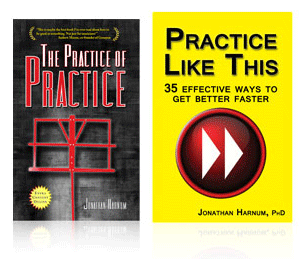
Until The Practice of Practice, there hasn’t been a book on practice written for musicians who aren’t interested in the school musics (band, choir, and orchestra). The good news is that this book is also valuable for those folks, too. It’s useful whether you’re into Bach, Rock, or any other kind of music.
How Does Posture Affect Your Sound?
Posture is vital not only to a good sound, but will also help you avoid injury. Jazz trumpeter Ingrid Jensen gives a superb lesson about posture, why it matters, and how to do it. Listen and learn from Ingrid in the video below:
Great Classical Resource! Musaic Intro from Michael Tilson Thomas
Michael Tilson Thomas introduces a new service on Musaic for orchestral musicians and anyone interested in learning more, like what a concertmaster actually does, or videos on trumpet, cello, flute, violin, piano, but not so much on saxophone, as you might expect. You can find players, like Yo-Yo Ma, and some very cool videos of composers pieces like the one for Steve Reich’s Music for 18 Musicians. Below is a talk by Thomas that’s pretty entertaining, and might introduce you to a new way to relate to classical music. Check it out:
How to Manipulate Your Audience and Make Them Love It
Jazz and popular music of today owes a huge debt to Africa where the driving steady rhythm, swing, and accenting beats 2 and 4 come from. Most audiences in the US don’t know this, and don’t feel that kind of beat. Because of this, audiences frequently end up clapping on beats 1 and 3, as they’re doing in the clip below. Harry Connick Jr. knows better, and he also knows how to turn the beat around so he can help the audience clap on 2 and 4 (that happens around the :39 mark in the video below). His drummer is happy about it and gives a double-fist pump right after Connick makes the switch. Notice how much more hip the sound is!
Cover Yourself: Why You Should Copy Your Musical Heroes
Music, like many things, is best learned through imitation. By recreating the sounds you love, you’re literally embodying that knowledge. Owning it. It doesn’t matter if it’s Bach, Beastie Boys, or Benny Golson, figuring out and recreating your favorite tunes is what every single one of the best musicians you’ve heard do in the quest to become a great musician.
Our brains are literally wired for imitation. I’m talking about the mirror neuron system a topic that’s covered in detail in The Practice of Practice.
Here are a few performances by Kawehi, covering Nirvana’s Heart-Shaped Box, Michael Jackson’s The Way You Make Me Feel, and a couple others interesting musical inventions.
If You Can’t Sing It, You Can’t Play It: Voice Lesson
One of the best tools for your practice is your voice. Faced with a tough part, if you sing it, you’ll be able to play it better because you’ll be able to hear it better. Singing the passage allows you to “own” it in a deeper way than by pushing buttons or keys on your instrument. You don’t have to be a great singer to benefit from this kind of practice, but here’s a couple good videos on vocal tone production and breathing.
Carnatic Sax, Mental Practice, and Amazing Drumming
Check out these Indian musicians (the sax playing starts around 13 minutes in, after the drum battle/conversation). There is no movement without music. In some cultures there aren’t separate words for music and dance. Using the body to keep track, to groove, and to make better music is something all musicians do. The hand gestures you see in this video are one of the many ways Indian musicians manifest the music physically.
The Fractal Nature of Goals and Music Practice
Setting goals is one of the most powerful things you can do to get better at music or anything else. Some people write them down, some just have a vague idea of what they are, but we all have goals for nearly everything we do. Goals are covered in more detail in The Practice of Practice, but here’s a quick run-down. Goals are like the cool animated GIF of a Sierpinsky fractal above: there are goals within goals within goals. It’s goals all the way down. The usual advice is to break goals down into long-term, mid-term, and short-term goals, but you can and should dive deeper, and consider smaller goals.
Motivation to Practice: Go With the Flow
There’s a lot to like about the video of pianist Glenn Gould below. I’ve highlighted three things that happen in the video (see clips below).
As the great Robert Krulwich (of Radiolab and NPR) pointed out in a recent post, Gould appears to be deep in a Flow state, practicing Bach’s Partita #2.
 The Practice of Practice