Cover Yourself: Why You Should Copy Your Musical Heroes

Music, like many things, is best learned through imitation. By recreating the sounds you love, you’re literally embodying that knowledge. Owning it. It doesn’t matter if it’s Bach, Beastie Boys, or Benny Golson, figuring out and recreating your favorite tunes is what every single one of the best musicians you’ve heard do in the quest to become a great musician.

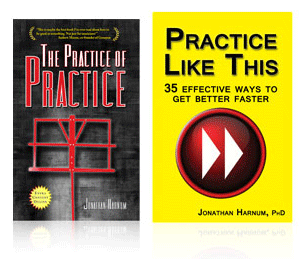
Our brains are literally wired for imitation. I’m talking about the mirror neuron system a topic that’s covered in detail in The Practice of Practice.

Here are a few performances by Kawehi, covering Nirvana’s Heart-Shaped Box, Michael Jackson’s The Way You Make Me Feel, and a couple others interesting musical inventions.

100 Days of Art – Day 28: The Roberts McFerrin

Originally posted on The Artists' Sanctum:
Many of you have probably heard of Bobby McFerrin, below, noted singer, musician, and one-man voicechestra/multi-octave singer, beat-boxer, and, conductor. However, did you know that he’s actually Robert McFerrin, Jr. and his father was noted baritone Robert McFerrin (1921-2006)? Robert Keith “Bobby” McFerrin, Jr. Robert Keith McFerrin, Sr. No,…

Two-Year-Old Rapper: In the Flow, Laying It Down Like a Boss

All humans are musical. In that sense, musical ability is genetic. We all have musical potential. But like all genes, our musical potential reacts in a dynamic relationship with the environment (no matter what age we are). There is no nature OR nurture, it’s always nature AND nurture. Here’s a great and adorable example: Two-year-old Khaliyl Iloyi rapping with his dad, Femi. Little dude’s got some skills! And he got those skills not because he’s got some natural ability, but because he’s growing up in a musically rich environment.

Tricky Sam Nanton: It Don’t Mean a Thing

Check out Tricky Sam Nanton’s solo in the Duke Ellington band. He had a great vocal sound on the trombone that nobody has equalled since. His solo starts at 1:11. A short clip from some of the greatest pop musicians of the 20th century in the US. Info about the tune and some of the musicians below:

If You Can’t Sing It, You Can’t Play It: Voice Lesson

One of the best tools for your practice is your voice. Faced with a tough part, if you sing it, you’ll be able to play it better because you’ll be able to hear it better. Singing the passage allows you to “own” it in a deeper way than by pushing buttons or keys on your instrument. You don’t have to be a great singer to benefit from this kind of practice, but here’s a couple good videos on vocal tone production and breathing.

Carnatic Sax, Mental Practice, and Amazing Drumming

Check out these Indian musicians (the sax playing starts around 13 minutes in, after the drum battle/conversation). There is no movement without music. In some cultures there aren’t separate words for music and dance. Using the body to keep track, to groove, and to make better music is something all musicians do. The hand gestures you see in this video are one of the many ways Indian musicians manifest the music physically.

The Fractal Nature of Goals and Music Practice

Setting goals is one of the most powerful things you can do to get better at music or anything else. Some people write them down, some just have a vague idea of what they are, but we all have goals for nearly everything we do. Goals are covered in more detail in The Practice of Practice, but here’s a quick run-down. Goals are like the cool animated GIF of a Sierpinsky fractal above: there are goals within goals within goals. It’s goals all the way down. The usual advice is to break goals down into long-term, mid-term, and short-term goals, but you can and should dive deeper, and consider smaller goals.

A Growly Clarinet: Gypsy-style “Caravan”

The growly clarinet tone in the video is produced by growling in the back of your throat while playing. Great sound! There’s an absolutely wonderful version of Cootie Williams (trumpet) doing this Juan Tizol-penned tune.

The Percussion Instruments at the End of Your Wrist

Another post introduced the importance of rhythmic skill, and how using a percussion instrument at the same time as your other instrument can add greater depth and rhythm to your ability on your main instrument. The video below combines all of that wonderfully in an epic a capella patty cake singing performance, shot in 1 take.

Adopt a Drum: Practicing Rhythm

Rhythm is one of the most fundamental musical elements, in my opinion, one of the most important and most powerful. Unless we’re a drummer, our focus on rhythm often is overshadowed by other demands of the instrument or voice: tone production, fingering, intonation, and more. Here are three kinds of rhythmic activity you can add to your practice.

Motivation to Practice: Go With the Flow

There’s a lot to like about the video of pianist Glenn Gould below. I’ve highlighted three things that happen in the video (see clips below).

As the great Robert Krulwich (of Radiolab and NPR) pointed out in a recent post, Gould appears to be deep in a Flow state, practicing Bach’s Partita #2.

Yo-Yo Ma: “So whatever you practice for…that fails is all right, because we have a greater purpose.”

Yo-Yo Ma is a world treasure, and his perspective, playfulness, artistry, and educational inclinations make him one of my absolute favorite musicians. His Silk Road Project creates some of the most interesting musical collaborations I’ve ever heard. Check out the video below. I think you’ll agree. Below the video is a link to a wonderful interview with Yo-Yo Ma in which he talks about a wide range of topics, including–you guessed it–practice.