This interactive score of Petrushka is a gold mine for anyone interested in the piece. Stravinsky wrote Petrushka when he was 28 years old, in 1910-11. It’s a wonderful piece of music, and even if you’re not a classical musician, this site is a feast for the mind and the ears. Follow along in the highly interactive score, learn about what the different parts represent, learn about the historical context, and listen to commentary from music luminaries on the piece. There is something for everyone here: players, teachers, and even young children.
Category: How
Kenny Werner’s Practice Snapshots
Pianist Kenny Werner’s book Effortless Mastery has helped a lot of people who struggle with the fear of performance. He’s started a new blog, and part of the blog is a series of videos on how he practices. I’m excited to hear and watch these videos, and encourage you to check them out the first three below.
You Think YOU Have Stage Fright? Pianist Maria João Pires Has You Beat
Imagine you’re on stage, with an audience quietly listening, and when the conductor gives the orchestra the first downbeat, they begin to play another concerto, one you have not prepared. What would you do? You can watch what Maria João Pires did below.
12 Rules of Music Practice (Wynton Marsalis)
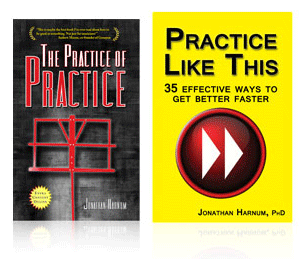
Here are 12 practice suggestions from Master Marsalis. Each one could be the subject of a book on its own. After the vids, I’ve added suggestions to consider below each of Wynton’s rules. Some will be covered more thoroughly in the book, “The Practice of Practice.”
Heard: A Practice Recording App with a 5-minute Buffer
It can be tough to know exactly what to record beyond a specific performance of a song or section. Sometimes, when I’ve been improvising or goofing around during the warm-up, or making a “creative error” while transcribing a solo, I really like the results. When I stumble across a neat musical idea, if I don’t stop to capture it by repeating it or writing it down, it’s gone, usually never to return. Now there’s an app for that.
The 10,000-hour Red Herring
You’ve all heard it by now: all the talk and focus on the 10,000 hour “rule,” from people like Malcolm Gladwell, and the researcher who originally published the study with the finding, Anders Ericsson, whose theories are not without opposition in the academic world. If you haven’t heard of this finding by researchers Ericsson, Krampe, & Tesch-Romer yet, it goes like this: it takes 10,000 hours of practice to reach expert-level performance, whether it’s in sports, music, chess, or x-ray diagnostics. But the 10,000-hour rule is a red herring for several reasons.
Cover Your Assessment: Musical Elements Checklist
Stumped on what to listen for in your practice? Use the musical elements as a checklist. Want to learn more about the best ways to practice? Get an e-mail with a discount code when The Practice of Practice is published (June, 2014). To learn more about the book, check out a sample from The Practice of…
SoundSlice: YouTube Learning Goodness
If you’re like me, you get a lot of learning done on YouTube, but isolating a passage and repeating it, let alone notating it in some way, is difficult if not impossible. Not any more! Check out SoundSlice.
SoundSlice is a fantastically useful tool geared towards guitarists, but it’s useful for anybody who learns by watching video. Adrian’s done many cool things as a programmer (check his site), and has an album out of his most popular fingerstyle tunes here, most of which you can also find on SoundSlice, like the Beatles tune, Yesterday. Check out the link to Yesterday for a good example of how the site works.
Performance as Practice
When I asked Nicholas Barron about how he practices, he said, “I never practice.” I was intrigued, because the dude can play guitar and sing, and has clearly spent a lot of time doing it. Over the course of the next 90 minutes, he shared the details of what “I never practice” means to him. Performance-as-practice is a focus Nicholas shares with a lot of pop musicians.
Nicholas Barron is a soulful Chicago singer-songwriter who looks like Vince Vaughn (but funnier), and he sounds like the love-child of John Lee Hooker, John Hiatt, and Joni Mitchell. James Taylor called Nicholas “undeniable” at New York Times’ Emerging Artists Series in 2007. Nicholas’s songs are playful, thoughtful, and heartfelt. I’ll tell you a little about his performance-as-practice approach.
Check out the vid of one of his more popular tunes, “I’m Not Superman” below.
Johnny Cash on Failure
“You build on failure. You use it as a stepping stone. Close the door on the past. You don’t try to forget the mistakes, but you don’t dwell on it. You don’t let it have any of your energy, or any of your time, or any of your space.”
Here’s another iconic image of Johnny Cash. I love this one, and like to think this is a good representation of my own attitude towards failure. The story of the image is told by Alex Selwyn-Holmes on his interesting website Iconic Photos. After the quote is a 1959 video of Johnny Cash playing Folsom Prison Blues.
12 Rules of Practice, from Wynton Marsalis
Wynton Marsalis is a musician who knows how to practice. As a younger man, he was equally at home in front of a symphony orchestra playing the Haydn concerto, or laying down some serious jazz with Art Blakey. Check out Wynton’s discography for more evidence. For a while now, he’s turned his full attention to traditional jazz…
Mr. Bean’s Imaginary Drum Set, or, Mental Practice
Here’s Rowan Atkinson with a pretty funny skit. It’s like he’s mentally practicing drums, and we get to hear what he’s hearing inside his head to hilarious results. Enjoy, and use this to remind you to inject mental practice into your own practice routine.
 The Practice of Practice