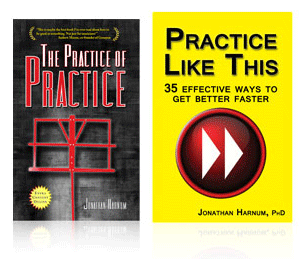
Feeling is everything in music. Or very nearly so. No matter what kind of music we listen to, we know it when we hear it. It’s so important that most listeners can perceive the emotional content in just a 1 second slice of sound! What is it that makes a piece of music expressive? It’s the musician herself that does, of course. But how does one go about learning how to do that? How do you convey feeling through sound? It’s the same answer as just about anything having to do with musical skill: you practice! But what does that mean? How do musicians practice the expressive aspects of music? Well, it turns out there is a piece of 2009 research that chronicles how 18 classical musicians do it
Category: Links
Book Review: “Free Play,” by Stephen Nachmanovich
Free Play doesn’t deal directly with music practice, but it is nevertheless an important book for anyone interested in music (or other arts, or life). I strongly believe that improvisation benefits practice. To me, improvising is an essential musical skill, one possessed by musical greats (Hussein, Bach, Shankar, Beethoven, Duke, Mozart, etc.), and is practiced in musical traditions all over the world, as well as by young children who haven’t developed some of the fear associated with improvisation in those overly focused on the written notes. Remember when you drew letters over and over as a young child, taking great care (or not) with the shapes? Now imagine that despite all that practice time forming letters and sounding out words, that you never (ever) spoke extemporaneously. Crazy, right? To me, that’s about the same as practicing scales over and over until they’re memorized, but then never using that tonal material to improvise. Crazy talk! At the end of this review is a link to an mp3 of my improv group Meh! playing an improvised story with Nachmanovich.
When is Not-Practicing Practice?
A new piece of research shows that the “inherently unpleasant” idea about deliberate music practice may not be entirely true. In fact, we may continue to learn when we’re doing something completely different from that which we’re practicing.
Reading & Writing Music is for Amateurs
There are worse musicians to emulate than Irving Berlin. He penned God Bless America, and the perennial classic White Christmas along with a whole host of other popular songs. Any songwriter would relish the royalties of either of these tunesand would probably both give their eyeteeth to have written them. Berlin knew the value of work. He didn’t believe in inspiration, but in effort. He wrote a song a day, regardless of fickle”inspiration.” The wonderful thing is that all of these musical accomplishments weren’t hampered by Berlin’s inability to read or write kusic. In fact, later in life, Berlin was convinced this inability was one of the factors in his success. He wasn’t limited by written music.
Major Scales and Their Kin
A series of lessons in which I explain the major scale, all its modes, relative minor, Major and minor pentatonics, and the related blues scale. I posted it to help trumpet players learn the fingering of their scales, but the concepts can help anyone and getting the sound of each scale into your memory is essential.
Grow an Inner Carrot, Forget the Stick
One thing the research record tells us is that incentives and other forms of extrinsic motivation don’t work very well to motivate us, nor do punishments. Carrots and sticks only work if you’re an ass. Much better is motivation that comes from within, or intrinsic motivation. And sometimes training can be a hindrance, too, as you’ll see in the vid below. Because I’m buried in research, I don’t have much time this week to post a lengthy article, but this thought-provoking TED talk is a great way to see the real-world example of how incentives often mean horrible performance, and training isn’t always a good thing. Learn the simple reason why kindergarten kids beat out MBAs in a design challenge…
Michel Godard Plays a Serpent
This is an excellent musical performance, and interesting to boot! The frame drum solo at the beginning drew me right in, and when Michel Godard began to play the serpent I was entranced. Godard’s ear and lip control put him completely in tune with the singer. A haunting mix of sounds. Vocals are provided by Linda Bsiri, and the masterful tef playing is by Jarrod Cagwin . According to the comments it’s both a sephardic tune, La Rosa Enflorese and is also known as Los Biblicos, traditional. I don’t know how accurate those comments are. Facts on the Internet are like notes on a trombone: Infinite in number, but most of them are wrong.
Good In, Good Out: Listening
Sound has an impact on us, a profound one. Whether it’s research showing that musicians can detect pitch difference language better; the discovery by Dana Strait–a friend and musical colleague of mine at Northwestern–that musicians are better at identifying emotion in sound; that trees communicate with sound; or that sound can also affect human development in a negative way as presented by Julian Treasure below in a six minute video.
Free Music e-Books & a Trumpet Book Podcast
Many changes in the wind this week. In celebration of the new Sol Ut Press web site, you can get a free eBook copy of two of my books Basic Music Theory: How to Read, Write, and Understand Written Music and Sound the Trumpet: How to Blow Your Own Horn. Tell your friends. I’ll be giving an unlimited number of eBook giveaways for the next month. When I’ve done this sort of thing the past, it usually works out to around 10,000 copies per month. I hope to break that record.
Wynton’s Artistry
No quotes, few words of mine so you can get to what Wynton Marsalis has to say (and sing):
If you cherish art, music, freedom, laughter, poetry, and masterful performance, you need to watch this.
http://www.wyntonmarsalis.org/2009/04/10/video-nancy-hanks-lecture-at-kennedy-center/
Jamming with Butterflies (in a pool of water)
just heard about Hermeto Pascoal, a guy Miles Davis said was “the most impressive musician in the world”. I’m amazed by how many flavors of musician are in the world and am equally stunned when I find yet another important one I’ve never heard of and wish I’d discovered much earlier. Hermeto Pascoal is from Brasil, and this is how he does it (PS: the riot of yellow butterflies that come to dance around their heads are worth waiting for @ 2:30…. (big thanks to Meara O’Reilly on BoingBoing for this one):
Beginnings
Planning is an essential part of your practice session. Imagine the planning that went into the video above, and ask yourself how much planning goes into your practice sessions. Every book I’ve read on practice, and every research article that looks into what musicians do when they practice mentions the importance of planning out your practice session. This includes broader plans like goals, as well as more specific things like exactly which pieces or skills you’re going to tackle and how you’re going to tackle them. This planning stage is only one part of a 3-stage process used by most of the people studied by McPherson and Zimmerman in a 2002 study. Here’s what it looks like:
 The Practice of Practice