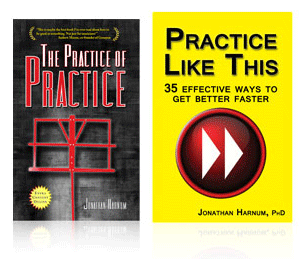
Many changes in the wind this week. In celebration of the new Sol Ut Press web site, you can get a free eBook copy of two of my books Basic Music Theory: How to Read, Write, and Understand Written Music and Sound the Trumpet: How to Blow Your Own Horn. Tell your friends. I’ll be giving an unlimited number of eBook giveaways for the next month. When I’ve done this sort of thing the past, it usually works out to around 10,000 copies per month. I hope to break that record.
Wynton’s Artistry
No quotes, few words of mine so you can get to what Wynton Marsalis has to say (and sing):
If you cherish art, music, freedom, laughter, poetry, and masterful performance, you need to watch this.
http://www.wyntonmarsalis.org/2009/04/10/video-nancy-hanks-lecture-at-kennedy-center/
Book Review: The Inner Game of Music by Barry Green
The Inner Game of Music by Barry Green, with Timothy Gallwey
15 chapters
225 pages
This book is based on Gallwey’s quite successful title, The Inner Game of Tennis. What is striking and admirable is that Green didn’t just write a knockoff cribbed from Gallwey’s book. After meeting with Gallwey about the project, they decided Green should live with (and teach) the principles and then write the book. Three years later, Green was ready and this book is the result.
Jamming with Butterflies (in a pool of water)
just heard about Hermeto Pascoal, a guy Miles Davis said was “the most impressive musician in the world”. I’m amazed by how many flavors of musician are in the world and am equally stunned when I find yet another important one I’ve never heard of and wish I’d discovered much earlier. Hermeto Pascoal is from Brasil, and this is how he does it (PS: the riot of yellow butterflies that come to dance around their heads are worth waiting for @ 2:30…. (big thanks to Meara O’Reilly on BoingBoing for this one):
Beginnings
Planning is an essential part of your practice session. Imagine the planning that went into the video above, and ask yourself how much planning goes into your practice sessions. Every book I’ve read on practice, and every research article that looks into what musicians do when they practice mentions the importance of planning out your practice session. This includes broader plans like goals, as well as more specific things like exactly which pieces or skills you’re going to tackle and how you’re going to tackle them. This planning stage is only one part of a 3-stage process used by most of the people studied by McPherson and Zimmerman in a 2002 study. Here’s what it looks like:
Book Review: The Art and Technique of Practice, by Richard Provost
Without Unceasing Practice nothing can be done. Practice is Art. If you leave off you are lost. ~William Blake (1757 – 1827)
———————————————————————–
Book Review: The Art and Technique of Practice, Richard Provost (1992)
Provost’s take on practice is simple and easily digested. Lots of white space on the 56 pages, and that’s a good thing, especially if you’re starting out. The book is an excellent primer for those new to practice and contains a wealth of basic information. The book’s got 6 chapters:
Mental Floss
It’s six AM and I’m sitting in a lifeguard chair as early-bird lap swimmers make their wet way up and down the pool lanes. I try to make the best use of my time while in the chair, but I still have to keep a close watch on the swimmers. So of course, I practice. Even though my trumpet is not in my hands I get a lot of work done and still do my job. Besides, playing trumpet early in the morning won’t make you any friends, even if (especially if?) you’re playing reveille. Today’s post is about a practical technique that all experts use, whether they’re musicians, athletes, or surgeons. You can (and should!) use them to improve, too. I’m talking about mental practice.
Born Stupid: Your Plastic Brain, III
I keep hammering away at the brain’s ability to re-wire itself because 1. It’s so darn fascinating, and 2. To combat the old saw that “you can’t teach an old dog new tricks,” which research is telling us is completely false. Here’s some more evidence of the lifelong plasticity of the brain. To anyone over 18 who is considering doing something new and unfamiliar, the following vid should be required watching.
Huge Chunk of Awesomeness
A wii remote, percussion, a bunch of servos and solenoids, some 12-tone set theory algorhythms (that word’s a joke, not a typo :-), looping functions, machine improvising and you get this huge chunk of awesomeness. First a performance and then how it’s done. This is so cool and amazing I simply don’t know what to say. Watch Patrick and his “band” Jazari and be inspired and flabbergasted. I wonder how he practices…..
Fail Better
In a previous post I spoke of the necessity of failure. I mentioned Buddha’s belief that the obstacle is the path, and when watching an interview with olympic speed skater Apolo Ohno, I’m reminded of it again, but in a different way. Here’s the thing:
After the 1500 meter race in which he won bronze, thereby becoming the most decorated American winter olympic athlete, Ohno said something interesting in an interview after the race. He was clearly happy, but spoke about a little bobble near the end of the race, when the Canadian skater bumped him as they went around a turn and Ohno’s skate stuttered. What did Ohno say in the interview? Did he blame the dastardly Canadian for bumping him? No. He took full responsibility for the stumble and wondered (I’m paraphrasing), “If I hadn’t messed up there I might have placed better.” Ohno is giving a perfect positive example of what researchers have called attribution theory, or what I like to call, The Blame Game. Here’s how it works:
More Freebies
Information wants to be free, and the Internet makes that happen. A good friend teaching music in Pakistan and who is now moving to Manila to continue teaching music turned me on to a wiki for the Petrucci Music Library, a repository of free sheet music that is in the public domain. You can search by composer, by composer nationality, by period, and by type of work. What a great resource! They’ve been online for 4 years now, and I’m wondering how I missed it. I hope you can find something to use there.
Go Gumbo, Go Ya-Ka-May
Michelle and I were in a little bar somewhere in the French quarter of New Orleans, halfway through a 2-year road trip (yes, you heard that right), and the tight Reggae band we’d been listening to took a break and never came back. We stood outside in the drizzle, not ready to go back to the VW camper but we had no idea where to go and had no money for a cab. In the distance, we heard music. It sounded like a brass band, and they sounded smoking hot. We were afraid it was only a recording, but had to find out for sure, so we followed our ears through the drizzle to a little corner bar that was thumping!
 The Practice of Practice