Music is abstract and fleeting. You can’t see it, and except for the past 100 years, music isn’t preserved, at least not in the way visual art is preserved. This makes it tough (or impossible) to see how musicians progress. There is however, a lot of evidence of how visual artists progress. It’s yet one…
Tag: practice
First Video of A Thought in the Brain
I often post about brain-related issues and music practice. This video is more general than usual, but I present it to you because of its interesting uniqueness. The first video footage of a thought sparking through neurons (the video says it’s 3x normal speed). Details about the process here.
This made me think about a few things: How were those neurons and the connections “built” or grown? Is a firing of neurons really a thought? What is a thought?
Your Brain on Music (fMRI)
Music doesn’t make you smarter, at least not generally smarter, but playing music does make you musically smarter. In fact, there have been many recent studies showing profound differences in the brains of people who have studied music. One is that the corpus callosum, the “conduit” between the left and right sides of the brain, is…
Basic Practice Skills
It can be hard to know where to start with your practice, so here are a few quick, easy tips to keep it simple. Want to learn more about the best ways to practice? Get an e-mail with a discount code when The Practice of Practice is published (June, 2014). To learn more about the…
Practice on a Tiny Drum Set
This has me thinking about portable practice. Would practicing these drum set skills transfer to a real set? Maybe. Either way, it would be fun. There are all kinds of “travel” instruments out there for surreptitious practice: pocket trumpets, travel guitars in many configurations, and now, this drum set. First vid is the drum solo,…
Drone Your Way to Excellence
Several months ago I spoke with the fantastic jazz trumpeter Ingrid Jensen about practice. She mentioned that one thing she liked to do was practice with drones, using an Indian instrument called a tanpura (also tampura). She said that playing against a drone was a great way to train your ear/horn coordination. Practicing with a drone allows you to really feel how it sounds to play every note against the tonic, throughout your range. It’s meditative.
Ingrid Jensen
When I hear a great practice idea, I try it, and I’ve been using this one for a while and absolutely love it. I almost immediately noticed a greater ability to match pitch (my fellow musicians mentioned it in rehearsal), and a deeper awareness of sound in general. Part of the reason for this is that playing with the drone makes me aware of where the horn is naturally out of tune, whether because of the way a horn is made or because of the quirks of the harmonic series.
OK GO [Exclusive!] Making the video Needing/Getting
http://www.youtube.com/watch?v=qae4gAbXOZ8&feature=player_embedded#!
A follow-up to the post from a couple days ago. This project must have been a blast to work on.
OK-GO for the Win
What do you get when you mashup Blue Man Group with Inspector Gadget and Nascar? Probably something like OK-GO’s new romp of a video for their tune Needing/Getting.
What I love about this video is taking the idea of the size of an instrument to an absurd and wonderful extreme. It’s also a great way to visualize the form of a piece of music, since you can actually see instead of “just” hear where the form repeats. And the question I have is: how the heck do you practice that instrument?
OK-GO for the Win
What happens if you mix Blue Man Group, Inspector Gadget, and Nascar? You’d probably get something like OK-GO’s new video for their tune, Needing/Getting. What I love about this video is taking the idea of the size of an instrument to an absurd and wonderful extreme. It’s also a great way to visualize the form of a piece of music, since you can actually see instead of “just” hear where the form repeats. And the question I have is: how the heck do you practice that instrument?
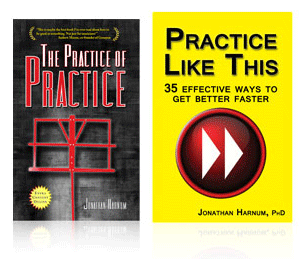
Cover Design for “The Practice of Practice”
Practice safe design: Use a concept.
~ Petrula Vrontikis
Well, after a good deal of thought and a couple years of writing on this book, the cover design is finally in.
The Fruits of Practice Sound Like This: Max Roach 5-Tet “Freedom Day”
Wow. I’ve always been a fan of Max Roach as soon as I first heard him, but this is some of the best playing I’ve heard, not only from Mr. Roach, but from everybody in this quintet. Eddie Kahn, after flying through some nimble-fingered walking bass delivers one of the most interesting upright bass solos I’ve heard in a while, and the way he locks in with Max Roach on drums is as tight as the bond of close friendship. Abbey Lincoln recently passed away, but her gorgeous contra-alto voice lives on powerfully in this music. Clifford Jordan’s fat tone on the tenor; Coleridge Perkins (I think) and his artful comping on piano, accentuating hits with Max Roach, who kills that drum set in the tastiest way: clean, and with total respect and communication with the other musicians, and even at these speeds is so relaxed and easy-sounding. Wheeew! This is great stuff. This is what practice sounds like.
Mistakes are Opportunities
I’ve written often about how important mistakes are in the learning process. Not just mistakes, but what you do with them once you discover them. That “discover them” part is the most important. If you discover them in the practice room, you’ve just stumbled on a place that needs attention and focused effort. If you discover them in your jazz combo during a performance, they’re not mistakes any more, they’re opportunities for communication. Here’s a wonderful video by jazz vibraphonist Stefon Harris explaining and demonstrating this idea. Happy winter celebrations everyone!
 The Practice of Practice