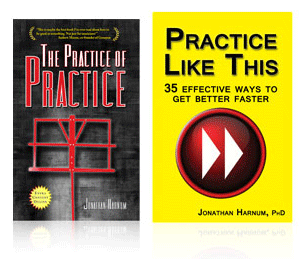
Stumped on what to listen for in your practice? Use the musical elements as a checklist. Want to learn more about the best ways to practice? Get an e-mail with a discount code when The Practice of Practice is published (June, 2014). To learn more about the book, check out a sample from The Practice of…
Tag: music
Music and the Brain on Radiolab
Radiolab is one of my favorite podcasts: smart, funny, thoughtful, and at times mindbending. All artfully mixed and mastered into great storytelling that teaches. Here’s an episode on music and the brain that should be required listening for musicians. Covers music and the brain, music and language, sound as touch, and musical DNA. Hope you like it as much as I did.
Not Your Daddy’s Metronome: Alem’s Mad Beats
The metronome is a pretty useful tool. At a workshop, jazz trumpeter Dave Douglas said he gave up practicing with a metronome because it’s too mechanical and he felt rhythm and beat was more organic, less mechanical and unyielding. I get that, and agree, but I’ve found the metronome to be useful for especially challenging…
What Excuse Holds You Back?
Anyway, at the fest this year, in casual conversation, I recounted Victor Wooten’s presentation a couple years ago which I posted on the blog. A high school kid raised his hand and asked how he could overcome the problem of having large hands. Victor set the kid straight. This picture of Chinese artist Huang Guofu overcoming (read: crushing!) his limitations reminded me of Wooten’s words of wisdom.
From Bad to Good
Music is abstract and fleeting. You can’t see it, and except for the past 100 years, music isn’t preserved, at least not in the way visual art is preserved. This makes it tough (or impossible) to see how musicians progress. There is however, a lot of evidence of how visual artists progress. It’s yet one…
Your Brain on Music (fMRI)
Music doesn’t make you smarter, at least not generally smarter, but playing music does make you musically smarter. In fact, there have been many recent studies showing profound differences in the brains of people who have studied music. One is that the corpus callosum, the “conduit” between the left and right sides of the brain, is…
7 Great Books for Musicians
Here are 8 great books for musicians on your gift list. Want to learn more about the best ways to practice? Get an e-mail with a discount code when The Practice of Practice is published (June, 2014). To learn more about the book, check out a sample from The Practice of Practice. ___________________________________________________ How Music Works, by…
This is How Moanin’ is Done
This is a great tune. It’s simple, but very easy to rush those quarter note and dotted quarter note rhythms. If you’re not paying attention, you’re gonna speed up instead of lay it back. Here’s how it’s done right, and Freddie blows a killer improvised solo. (changes in C are here, thanks to MRB) (Real Book, vol. 2 in which Moanin’ appears can be found in C (piano, guitar, etc.), Bb (trumpet, clarinet, t. sax), Eb (alto sax) and bass clef)
Stop! Hey, What’s that Sound?
The more musicians I speak to about practice in preparation for the new book, the more I’m reminded how extremely important listening is to one’s music. In fact, there’s some evidence in published research that all this time spent listening gives us musicians more ability to pull sound out of noisy environments (link to study)….
Practice on a Tiny Drum Set
This has me thinking about portable practice. Would practicing these drum set skills transfer to a real set? Maybe. Either way, it would be fun. There are all kinds of “travel” instruments out there for surreptitious practice: pocket trumpets, travel guitars in many configurations, and now, this drum set. First vid is the drum solo,…
Drone Your Way to Excellence
Several months ago I spoke with the fantastic jazz trumpeter Ingrid Jensen about practice. She mentioned that one thing she liked to do was practice with drones, using an Indian instrument called a tanpura (also tampura). She said that playing against a drone was a great way to train your ear/horn coordination. Practicing with a drone allows you to really feel how it sounds to play every note against the tonic, throughout your range. It’s meditative.
Ingrid Jensen
When I hear a great practice idea, I try it, and I’ve been using this one for a while and absolutely love it. I almost immediately noticed a greater ability to match pitch (my fellow musicians mentioned it in rehearsal), and a deeper awareness of sound in general. Part of the reason for this is that playing with the drone makes me aware of where the horn is naturally out of tune, whether because of the way a horn is made or because of the quirks of the harmonic series.
OK GO [Exclusive!] Making the video Needing/Getting
http://www.youtube.com/watch?v=qae4gAbXOZ8&feature=player_embedded#!
A follow-up to the post from a couple days ago. This project must have been a blast to work on.
 The Practice of Practice